Stephanie Browning McVicar from the Utah Department of Health talked about hearing screenings for newborns.
Link: http://kutv.com/features/health/baby-your-baby/baby-your-baby-hearing-screenings-for-newborns
Conference Celebrates Unprecedented High Literacy Rates Among Deaf Children
Top international researchers as well as visitors from around the United States, will converge at the 50th Anniversary of Cued Speech Conference, which celebrates the enormous success at increasing literacy among students who are deaf/hard of hearing since Cued Speech was invented a half century ago.
Link: http://www.prnewswire.com/news-releases/conference-celebrates-unprecedented-high-literacy-rates-among-deaf-children-300279232.html
The June Edition of Probes and Tips is Now Available
Read more about “Documentation Do’s and Don’ts” in the latest edition.
Link: http://archive.constantcontact.com/fs154/1102782899287/archive/1124867381653.html
Have you seen the Journal of Early Hearing Detection and Intervention?
Last February NCHAM published the first issue of the Journal of Early Hearing Detection and Intervention (JEHDI) as part of our efforts to disseminate information about how to continually improve EHDI programs. The aim of the JEHDI is to promote access to evidence-based practice, standards of care, and research focused on all aspects of Early Hearing Detection and Intervention. Taking a broad systems perspective, the JEHDI focuses on newborn and early childhood hearing screening, diagnosis, family support, early intervention, the medical home, information management, financing, quality improvement and other key factors critical for an effective EHDI system.
Since the first issue of JEHDI was released NCHAM has had 1,102 different people visit the JEHDI home page. NCHAM is now gearing up for the second issue that will be released in September.
Have you had a chance to take a look at what information is being shared? Look at all of the places in the world that already are. Check it out for yourself at http://digitalcommons.usu.edu/jehdi/.
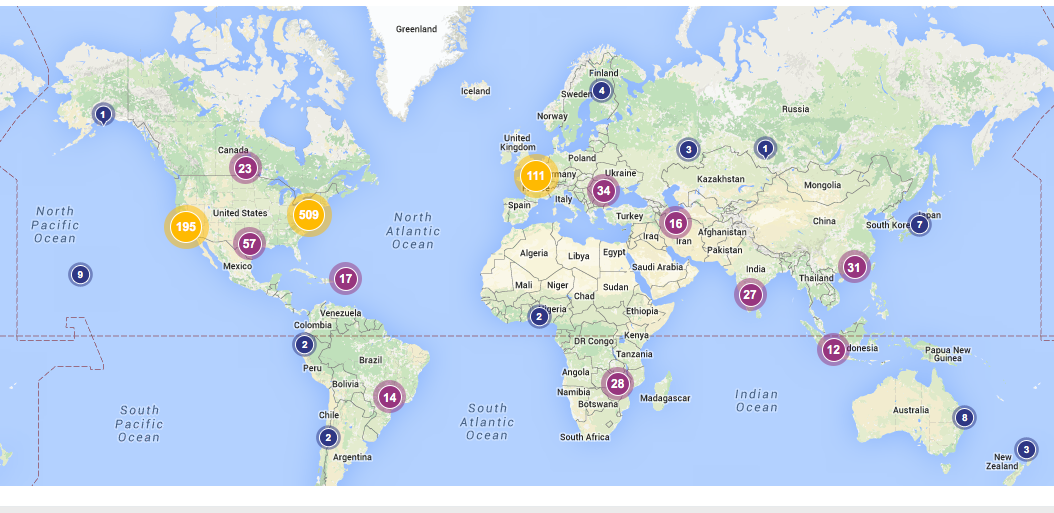
Link: http://digitalcommons.usu.edu/jehdi/
New deaf education alum ready to advocate for underrepresented students
Nervousness was taking over, and the four elementary students in front of her were looking at her, expectantly. Unlike her previous teaching experiences, these kids were deaf. In that moment, she asked herself: “Can I handle this?”
Link: https://news.illinoisstate.edu/2016/05/new-deaf-education-alum-ready-advocate-underrepresented-students/
Symbolic Play and Novel Noun Learning in Deaf and Hearing Children: Longitudinal Effects of Access to Sound on Early Precursors of Language
Find the abstract and study results at the link below.
Link: http://journals.plos.org/plosone/article?id=10.1371/journal.pone.0155964
Webinar Series Offered by NCMHI
|
Link: https://cc.readytalk.com/registration/#/?meeting=6rxvcug6s0j8&campaign=2rb580sv1bjb
Early Intervention and Family Involvement are Critical to a Child’s Success
Since an infant’s brain is like a ball of clay when it comes to learning power, Cathy Estes knows the early months and years of life are crucial to future success.
Link: http://www.gbtribune.com/section/69/article/96349/
Parents of Deaf Children, Stuck in the Middle of an Argument
A long-simmering controversy erupted this spring over how deaf children should communicate.
Link: http://well.blogs.nytimes.com/2016/05/24/parents-of-deaf-children-stuck-in-the-middle-of-an-argument/?module=WatchingPortal®ion=c-column-middle-span-region&pgType=Homepage&action=click&mediaId=thumb_square&state=standard&contentPlacement=14&version=internal&contentCollection=well.blogs.nytimes.com&contentId=http%3A%2F%2Fwell.blogs.nytimes.com%2F2016%2F05%2F24%2Fparents-of-deaf-children-stuck-in-the-middle-of-an-argument%2F&eventName=Watching-article-click&_r=1
Texas students use 3D printed otoscope to fight hearing loss in developing world
While most biomedical research projects involving 3D printing have access to immense budgets, one team of Texas students just proved that even low-cost desktop 3D printing can have a huge impact on the medical world. For just $6.42, they can build a 3D printed otoscope smartphone attachment, which can help diagnose preventable hearing loss. A perfect tool for doctors and patients in developing countries where a lot of people have smartphones, but hardly have access to medical care.